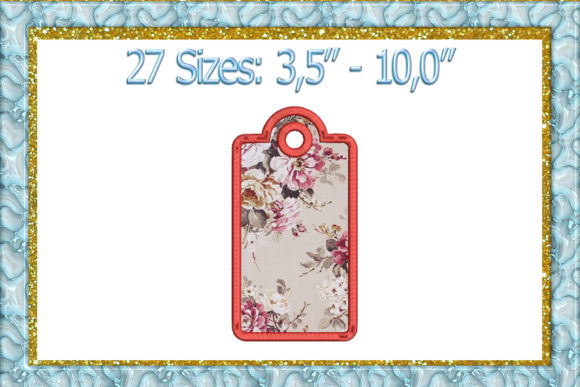
Price Tag Applique
A Practical Review for Small Business Branding & Embroidered Patches
As an embroidery designer who’s developed hundreds of commercial designs for cafés, boutiques, bakeries, florists, and handmade brands, I approach every new machine embroidery design with two questions: Does it reinforce brand identity? and Will it hold up in real-world production? When I first saw Price Tag Applique, my instinct was immediate—it’s not just decorative. It’s a functional, narrative-driven embroidery file built for storytelling at a glance. The name alone signals value, pricing transparency, and artisanal authenticity—qualities small businesses lean into hard.
First Impression: Friendly, Handmade, and Professionally Versatile
Price Tag Applique reads as warm but intentional—not overly cutesy, not sterile. It suggests craft without sacrificing polish. For a local pet brand stitching tags onto bandanas, a florist branding canvas totes, or a bakery embroidering aprons, this design lands right in the sweet spot between approachable and premium. It avoids dated clipart energy and doesn’t rely on trendy minimalism that fades fast. Instead, it feels like a deliberate choice—one that says, “We made this, and we stand behind it.” That impression matters deeply when customers touch your embroidered patch or see your cap embroidery across a farmers’ market booth.
Where Price Tag Applique Shines in Small Business Merch
This design thrives where branding meets utility:
- Embroidered patches – Ideal for sew-on or iron-on application on denim jackets, tote bags, or staff uniforms. Its balanced shape and clear visual hierarchy hold up well at 2.5”–3.5” sizes.
- Apron embroidery – Positioned on the chest or pocket, Price Tag Applique adds character without overwhelming function. It subtly communicates care and craftsmanship—key for food, retail, and studio environments.
- Cap embroidery – Works cleanly on structured front panels when sized appropriately (test at 2” width). Avoid curved bill placement unless digitized for distortion compensation.
- Tote bag design – A single Price Tag Applique on the lower corner or centered near the top edge gives handmade product packaging instant credibility.
- Custom apparel accents – Think sleeve details on work shirts, back-of-neck highlights on tees, or tag-style accents on reusable produce bags. It scales conversationally—not just decoratively.
- Printable mockups & digital assets – Because it’s delivered as a multi-format embroidery file, designers can quickly generate client-facing visuals before stitching begins.
Use With Intention: Where Caution Applies
Like any strong design, Price Tag Applique demands thoughtful execution. Here’s where attention pays off:
- Small patch sizes under 2” – Fine text or tight outlines may lose clarity. Always test stitch at final size—don’t rely on screen zoom.
- Curved surfaces – Cap fronts and tapered tote handles require stabilizer support and possibly adjusted underlay. Test on your target fabric first.
- Dark uniforms or textured fabric – High stitch density areas (if present) can flatten pile or obscure detail. Use tear-away + cutaway stabilizer combos and verify thread color contrast.
- Frequent washing – If used on aprons or staff shirts, confirm the design’s fill density supports durability. Overly dense fills may crack; too sparse may fray.
How Price Tag Applique Strengthens Brand Identity
In merchandising, consistency is trust. Price Tag Applique isn’t just a logo replacement—it’s a thematic anchor. When stitched beside your shop name on a tote or woven into a product label, it quietly reinforces your story: handmade, transparent, valued. Customers don’t just see a tag—they register intention. That translates directly to perceived product value and repeat engagement.
For Etsy sellers and craft-based businesses, this design bridges the gap between “I made this” and “I run this like a business.” It lends professionalism without coldness—especially when paired with cohesive thread colors that match your palette (e.g., sage green + cream for a botanical brand, terracotta + oat for a ceramics studio).
Pro Designer Notes Before You Stitch
Before sending Price Tag Applique to production, here’s what I always do:
- Run a black-and-white test stitch first—this reveals spacing issues, legibility gaps, and density imbalances no screen preview shows.
- Check how it renders at your intended hoop size and smallest usable patch dimension. Resize only using your embroidery software’s true scaling—not free transform.
- Review thread colors against your fabric swatch. A light gray on navy may vanish; a bright yellow on kraft canvas may scream instead of whisper.
- Inspect letter spacing and outline integrity—tight kerning or thin strokes often collapse during stitching.
- Test on your actual fabric with proper stabilizer. Denim, canvas, twill, and polyester all behave differently—even with the same embroidery file.
- Create a printable mockup for client sign-off. A photo of the stitched patch on a tote or cap builds confidence faster than a vector preview.
- Compare Price Tag Applique alongside your other design assets—logo, icons, typography—to ensure visual harmony across touchpoints.
- Verify commercial licensing status. Since this is positioned for small business merch and branded patch use, confirm you’re cleared for resale and distribution before batch production.
Final Thought: More Than a Design—It’s a Brand Signal
Price Tag Applique belongs in the toolkit of any embroidery shop, apparel decorator, or small business owner building tangible brand equity. It’s not filler. It’s functional storytelling—compact, confident, and ready for the real world of tote bags, caps, aprons, and customer-facing merchandise. Whether you’re digitizing for a local florist’s seasonal pop-up or prepping files for an Etsy launch, this machine embroidery design earns its place by delivering clarity, charm, and commercial readiness—all in one clean, versatile package.