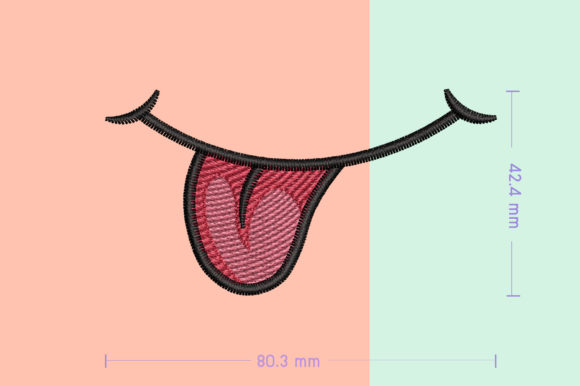
Smile Mouth with Tongue
A Playful, Instant-Charmer for Craft Fair Booths
As an embroidery designer who’s prepped over 200 craft fair booths—and watched which designs fly off tote bags and into customers’ hands—I’ll say it straight: Smile Mouth with Tongue lands as bold, fun, and unmistakably playful. It’s not farmhouse, not minimalist, not elegant—it’s joyful punctuation. That tongue-out grin reads instantly at three feet, cuts through visual noise on a crowded market table, and triggers a smile in under two seconds. For Babies category products, it adds lighthearted personality without saccharine cliché—think tiny embroidered onesies or bibs where whimsy feels intentional, not generic.
Where It Shines (and Where It Stumbles) on Real Handmade Products
Tote bags: Perfect as a small accent near the handle or centered low on the front panel. At 3–4 inches wide, Smile Mouth with Tongue reads clearly even on textured canvas and holds up beautifully in natural light—ideal for booth photography and Instagram reels.
Aprons and tea towel embroidery: Works best when placed high on the chest pocket or corner of a linen towel. Avoid dense stitching zones near seams; the tongue detail can blur if hooped too tightly on thick cotton twill. On tea towels, use lightweight cutaway stabilizer to prevent puckering around the curved mouth line.
Embroidered patches and fabric pouches: This is where Smile Mouth with Tongue earns its keep. As a standalone patch (2.5–3" wide), it’s eye-catching, gender-neutral, and scales well across age groups—from toddler backpacks to teen laptop sleeves. On small pouches, position it just above the zipper for maximum impact.
Caps and curved surfaces: Proceed with caution. The tongue’s narrow shape and tight curves demand precise digitizing—if the original embroidery file wasn’t optimized for caps, stitch distortion is likely. Always test on scrap fabric first and confirm hoop size compatibility before committing to batch production.
Pillow covers and market bags: A strong focal point at 5–6 inches. Keeps handmade quality visible from across the aisle and reinforces brand consistency when paired with coordinating fonts or simple geometric borders.
What Makes It Sell—Beyond Just “Cute”
This isn’t background decoration. Smile Mouth with Tongue functions as emotional shorthand: fun, approachable, confident. At craft fairs, buyers don’t pause for subtlety—they respond to energy. That upward curve + cheeky tongue combo creates instant relatability, especially among Etsy sellers curating joyful, non-cookie-cutter collections. It also photographs exceptionally well for digital listings: clean lines, high contrast potential, and zero tiny lettering or fine linework that disappears in thumbnail views.
For small shop products, it’s repeatable. You can produce 30+ embroidered tote bags in a weekend without design fatigue—no color blending, no gradient fills, no micro-details that require re-hooping every time. That means faster turnaround, lower error rates, and stronger booth display strength when grouped with complementary designs like hearts, stars, or simple rainbows.
Design Assets That Matter Most for Commercial Embroidery
Before loading Smile Mouth with Tongue into your machine, treat it like a live product—not just a digital embroidery file. Ask yourself:
- Does the stitch density feel balanced? Overly dense areas risk stiffness on soft fabrics like jersey or bamboo blends—especially relevant for Babies items.
- Will thread colors pop on dark fabric? Test contrast with matte poly or rayon threads; glossy threads may mute the tongue’s dimensionality.
- Is spacing generous enough for clean cutting around the patch edge? Tight margins cause fraying in wash-and-wear items.
- Have you confirmed commercial licensing? Since this is intended for finished product resale—not just personal use—you must verify rights before selling embroidered onesies or wholesale patches.
Practical Designer Notes You Can’t Skip
I’ve seen too many craft fair sellers discover mid-booth that their “fun” design vanished on navy terry cloth or bunched on a curved cap bill. So here’s my checklist—based on real mistakes made last season:
- Test on scrap fabric matching your final product’s weight and texture—especially for tea towel embroidery or apron embroidery.
- Review spacing and stitch density in your embroidery software. Look for overlapping jump stitches or areas where the tongue might tunnel under adjacent satin columns.
- Confirm hoop size before batching. If Smile Mouth with Tongue requires a 5x7 hoop but your travel setup only has 4x4, adjust or substitute.
- Use the right stabilizer: Tear-away for stable wovens (like cotton tote bags), cutaway for knits or stretchy Babies fabrics, and heavy cutaway for textured towels.
- Create at least one real mockup—not just a printable mockup. Drape it, hold it in daylight, snap a raw phone photo. Does the expression still read? Does the tongue look intentional—or like a glitch?
- Compare fabric colors side-by-side. What reads cheerful on ivory linen may read muted on oatmeal canvas. Adjust thread hue accordingly—not just brightness.
Final Thought: It’s Not Just a Design—It’s a Conversation Starter
In a sea of neutral linen, rustic wood tags, and muted palettes, Smile Mouth with Tongue is a deliberate burst of positivity. It doesn’t whisper—it winks. For Etsy sellers building a recognizable voice, for boutique makers refining their aesthetic, and for embroidery business owners scaling handmade product lines, this machine embroidery design delivers outsized return per stitch. It strengthens booth presence, lifts buyer engagement, and quietly signals craftsmanship—because executing a clean, dimensional tongue-out smile requires thoughtful digitizing, not just a clip-art import. Use it well, test it thoroughly, and let that grin do the talking.