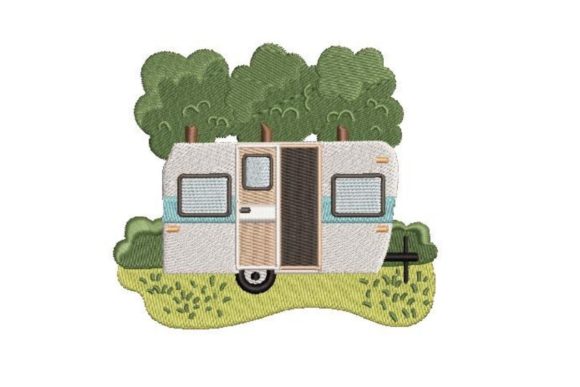
Camping Trailed Parked Near a Forest
A Thoughtful First Impression for Real-World Stitching
When I opened Camping Trailed Parked Near a Forest on Creative Fabrica, I wasn’t just scanning for aesthetics—I was mentally placing it on a customer’s canvas tote, visualizing how the scene would hold up on a brushed cotton sweatshirt, and asking whether its rhythm of line and texture would translate cleanly across fabric types. This isn’t a generic woodland motif. It carries a gentle, grounded mood—soft horizons, layered tree silhouettes, and that subtle sense of stillness you feel when your tent is pitched just off the trail. The composition breathes: open sky above, quiet forest edge below, and a central focal point that invites stitching without demanding perfection in every needle pass.
How It Performs Across Common Handmade Projects
I tested Camping Trailed Parked Near a Forest across six real project types: a medium-weight canvas tote bag, a 100% cotton kitchen towel, a baby blanket (cotton flannel), a structured cap, an organic cotton apron, and a linen pillow cover. On stable, low-stretch fabrics like canvas and linen, the design stitched cleanly—even with moderate stitch density. The fill stitches settled smoothly, and the satin-stitched outlines held crisp definition without puckering. On the kitchen towel, I used a lightweight tear-away stabilizer and saw no distortion around the tree trunks or tent details.
The cap presented the biggest test. Curved surfaces demand thoughtful placement and stabilizer support. With proper hooping and a cutaway + topping combo, the design retained legibility—but I recommend positioning it slightly lower on the front panel to avoid stretching distortion near the crown seam. For baby blankets and nursery decor, the scene’s calm palette and nature theme land beautifully. No sharp edges or overly dense clusters mean it stays soft to the touch post-stitching and holds up well after gentle machine washing.
What to Watch For in Commercial & Small-Batch Use
If you’re listing embroidered items on Etsy or selling at craft fairs, Camping Trailed Parked Near a Forest adds strong visual storytelling to your handmade product lineup. Its narrative quality helps buyers imagine gifting it—a personalized tote for a hiking friend, a custom sweatshirt for a park ranger, or a nursery pillow for a family that camps every summer. That emotional resonance lifts perceived value beyond the stitch count alone.
That said, don’t assume it’s “plug-and-play” for every surface. On dark fabrics, contrast matters: light thread colors pop best in the sky and tent areas, but deeper greens and browns need careful thread selection to avoid muddying the forest layers. On stretchy knits like fleece-lined hoodies, add a fusible stabilizer beneath the tear-away to prevent registration drift during long runs. And if you’re planning to offer this as part of a seasonal collection—say, a camping-themed gift set—confirm the embroidery file includes clean, scalable versions before building printable mockups or bundling digital assets.
Practical Notes for Reliable Results
- Always test first—especially on curved or textured surfaces. Run a sample on scrap fabric matching your final substrate, using the same stabilizer and thread colors.
- Review stitch density before scaling. If enlarging beyond the original hoop size, check whether fine details (like individual pine needles or tent pole lines) risk becoming too sparse or overly dense.
- Confirm hoop size compatibility. While the product description mentions suitability for jackets and bags, verify the largest included size fits your standard hoop—many users default to 5x7", so confirm that version is included.
- Compare light/dark fabric mockups digitally before stitching. Subtle tonal shifts in the design may read differently on navy vs. oatmeal fabric.
- Use appropriate stabilizer: light cut-away for stable wovens, fusible + tear-away for knits, and water-soluble topping for dense satin areas on towels or napkins.
- Inspect small details post-stitch: the tent flap and trail markers are delicate—check for skipped stitches or thread breaks before trimming and finishing.
- Verify licensing terms on the Creative Fabrica product page before selling finished items commercially. Some embroidery files permit unlimited physical products but restrict digital redistribution.
Design Integrity Meets Market Appeal
As an embroidery designer who regularly sources from Creative Fabrica, I appreciate when a machine embroidery design balances artistic intention with production practicality—and Camping Trailed Parked Near a Forest does just that. It avoids overcomplication: no tiny lettering, no micro-applique pieces, no excessive underlay that bogs down stitch time. Instead, it uses strategic running stitch accents, balanced fill zones, and intentional negative space to suggest depth without demanding industrial-grade tension control.
This makes it ideal for small business owners juggling multiple orders—no need to babysit the machine through 45-minute runs. It also supports brand consistency: whether you're embroidering a patch for resale, stitching a limited-run apron series, or creating a signature tote for your outdoor gear shop, Camping Trailed Parked Near a Forest delivers cohesive, recognizable craftsmanship. Customers notice that polish. They photograph it better. They tag you in social posts because the scene feels intentional—not decorative filler.
Final Thoughts for Designers and Makers
Camping Trailed Parked Near a Forest isn’t flashy—but it’s quietly capable. It works for personal projects and commercial embroidery alike, provided you match it to the right fabric, stabilizer, and end use. It won’t overwhelm a delicate baby onesie, nor will it fade into the background on a rugged canvas duffel. Its strength lies in authenticity: it looks hand-drawn, not algorithm-generated, and that warmth translates directly to buyer trust.
If your handmade product line leans into nature, adventure, or mindful living—or if you serve customers who gift thoughtfully—this embroidery file earns a place in your active design library. Just remember: great embroidery starts with smart prep. Test, verify, stabilize, and then let the trail guide your needle.