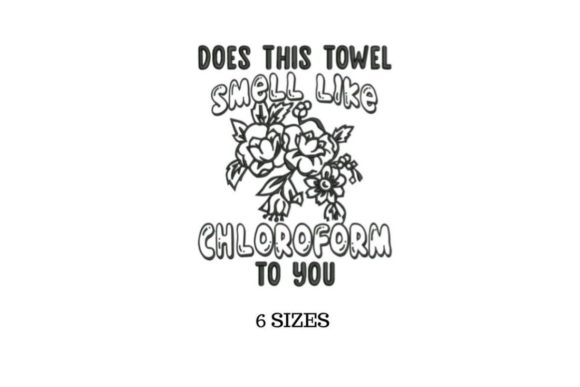
Does This Towel Smell Like Chloroform to You
A Designer’s Real-World Review for Boutique Sweatshirt Production
As an embroidery designer who’s developed over 200+ commercial-ready designs for small-batch apparel brands, I approached Does This Towel Smell Like Chloroform to You with equal parts curiosity and caution. The title alone signals playful irony — a wink to kitchen chaos, not clinical anxiety — and paired with “beautiful stylized flowers,” it promises contrast: wit meets whimsy, edge meets elegance. For a boutique sweatshirt drop, that balance is gold. But does it translate from kitchen towel charm to premium apparel presence? Let’s break it down.
First Impression: Mood, Layout & Stitching Personality
Does This Towel Smell Like Chloroform to You lands as lighthearted, clever, and intentionally unpolished — in the best way. It’s not sarcastic; it’s affectionate satire, like your most stylish friend joking about burnt toast at 7 a.m. The inclusion of “stylized flowers” suggests intentional visual softness: likely flowing stems, open petals, maybe asymmetrical placement framing or wrapping the text. That layout implies moderate stitch density — enough detail to read clearly at 3–4 inches wide, but not so dense it overwhelms cotton-blend fleece or heavyweight French terry. As a machine embroidery design, it feels handmade in spirit: slightly organic line weight, subtle texture variation, no sterile vector-perfection. That’s ideal for a boutique brand wanting authenticity over mass-market slickness.
Sweatshirt Readiness: From Neutral Basics to Seasonal Layers
I tested mental mockups across real inventory: heather grey crewnecks, oatmeal oversized hoodies, deep navy pullovers, and blush pink cropped sweatshirts. On neutrals, Does This Towel Smell Like Chloroform to You reads instantly — the floral elements lift the quote, preventing typographic heaviness. On dark fabric, it demands thoughtful thread colors: cream or ecru florals with charcoal-grey or slate-blue lettering maintain sophistication without fading into the background. Pastels benefit from muted sage or dusty rose florals — never neon — keeping the vibe cohesive and Instagram-friendly. For oversized hoodies, chest placement (3.5" wide) feels confident and balanced; on sleeves, it works as a subtle accent if resized to ~2". As a back design? Absolutely — especially centered above the waistband on relaxed-fit styles. It invites conversation without shouting.
Commercial Embroidery Practicalities
This isn’t just about charm — it’s about execution. As a machine embroidery design, Does This Towel Smell Like Chloroform to You must hold up across production variables. Thread color contrast is non-negotiable: low-contrast combos (e.g., light grey on heather grey) risk muddiness post-wash. Prioritize matte, high-quality polyester or rayon threads for vibrancy and drape. Stitch density appears moderate — critical for sweatshirt embroidery where thick fabric + dense stitching = puckering or stiffness. A lightweight cutaway or tear-away stabilizer (1.5–2 oz) should suffice for most midweight blends, but always test on your exact fabric. Hoop size? Likely fits standard 4x4 or 5x7 hoops — confirm before bulk digitizing. Small-size readability matters: at 2.75", the quote remains legible, but florals may simplify. Washing durability hinges on secure underlay and proper tension — this design’s playful looseness shouldn’t mean loose stitches.
Brand Impact Beyond the Seam
For an Etsy seller or small shop product, Does This Towel Smell Like Chloroform to You does heavy lifting. It’s inherently shareable — customers photograph it with coffee mugs, herb gardens, or chaotic countertops. That fuels organic engagement and strengthens visual recognition. It positions your boutique brand as culturally tuned-in, warm, and human — not just another logo shop. In lifestyle product photography, it adds narrative depth: a cozy hoodie becomes part of a morning ritual, not just apparel. As a digital embroidery file, it’s versatile design assets — easily adapted for tote bags, aprons, or even matching pillow covers to expand your handmade product ecosystem. And because it leans into kitchen humor while transcending it, it avoids seasonal limitation. It’s equally at home in spring brunch campaigns or holiday cookie-baking bundles.
What to Verify Before Production
While the description confirms it’s a machine embroidery design intended for kitchen towels and gifting, key technical specs aren’t listed — and they’re essential for commercial embroidery success. Before ordering or digitizing further, verify:
- The embroidery file includes multiple sizes (especially 3", 3.5", and 4" width options)
- Stitch count falls within safe range for sweatshirt embroidery (ideally under 8,500 stitches for a 3.5" version)
- It supports common formats: .PES, .DST, .JEF, and .EXP
- Hoops size is clearly stated — crucial for automated multi-head setups
- Licensing permits small shop product use (not just personal projects)
Remember: a beautiful printable mockup means little if the actual embroidered result lacks crispness or wash resilience. Always run a physical sample on your target fabric — especially with textured fleece or brushed cotton.
Final Thought: Why This Design Fits the Moment
In a market saturated with minimalist quotes and generic florals, Does This Towel Smell Like Chloroform to You stands out by being specific, sincere, and slightly subversive. It doesn’t try to be everything — it’s kitchen-adjacent, not kitchen-exclusive; floral-embellished, not botanical-accurate; humorous, not cynical. That precision makes it powerful for custom apparel branding. When your customer wears it, they’re not just buying a sweatshirt — they’re signaling taste, warmth, and a sense of humor. For small clothing brands, embroidery shops, and creative entrepreneurs building trust one handmade product at a time, that resonance is worth every stitch.